.svg)

Due diligence is, at its core, an information-processing challenge. Investment professionals must ingest large volumes of materials and data, extract relevant facts, synthesize insights across disparate sources, perform analysis, and form a judgment – all under significant time pressure.
Today, much of this process remains highly manual. Associates work around the clock to monitor data room uploads, locate key information, summarize documents, and manage diligence request trackers.
This approach is not only an inefficient allocation of talent—diverting highly trained teams toward low-value administrative work—but it also creates a structural bottleneck: the firm’s ability to absorb and respond to information is constrained by human bandwidth.
In a diligence environment defined by urgency, these constraints considerately increase execution risk. Important details may be overlooked, surfaced too late, or deprioritized amid the volume of incoming information.
This is the legacy paradigm.
Below, we outline how we believe generative AI will reshape private equity due diligence to materially improve both speed and quality of execution.
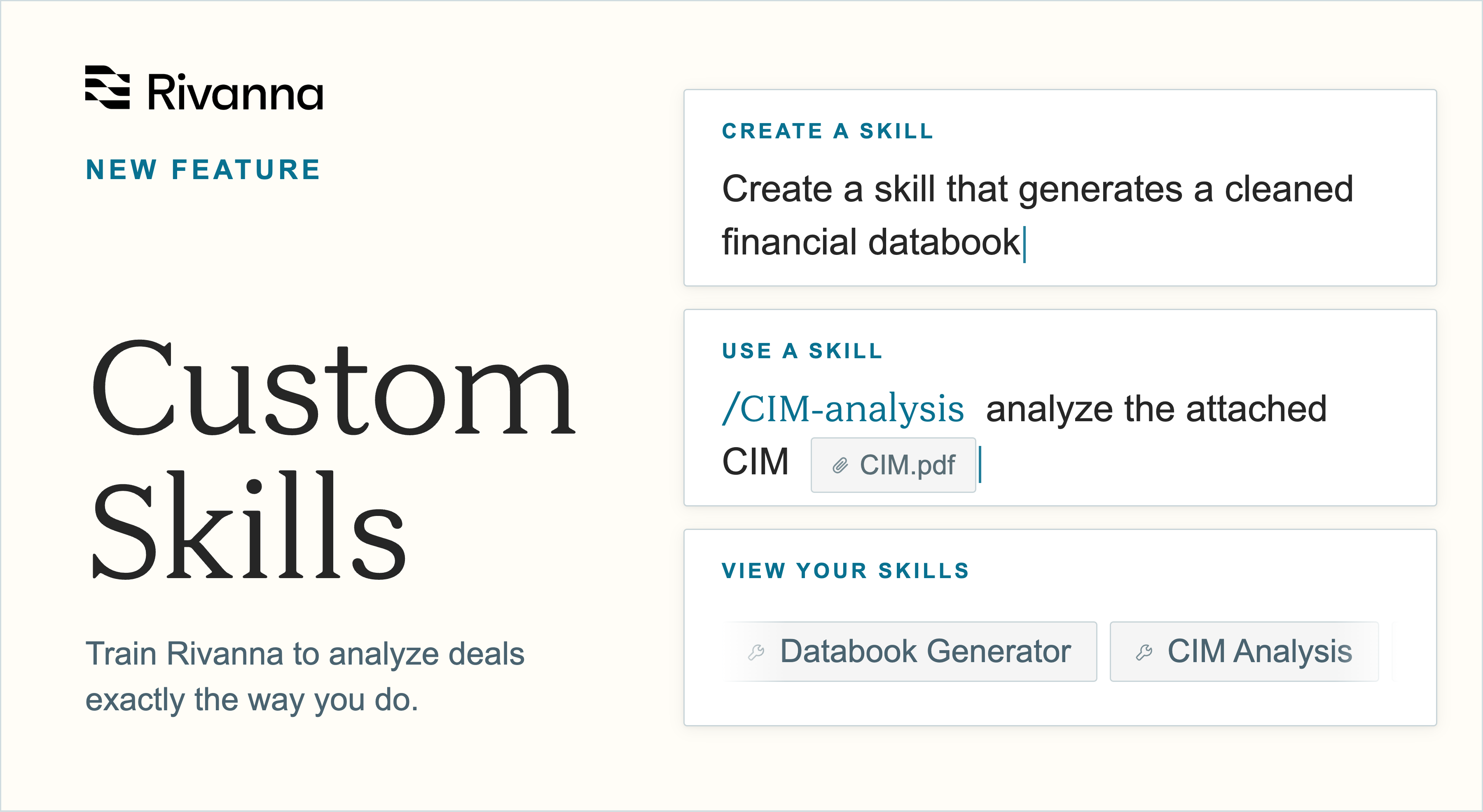
We at Rivanna are working to bring these capabilities into practice, delivering AI-driven tooling that helps investors operate with greater speed and clarity throughout the diligence process.
1) Synthesizes data room content into digestible diligence themes
AI can autonomously parse data rooms containing thousands of files and organize content into a structured set of topics and sub-topics. This allows deal teams to rapidly orient themselves to the most important materials, identify where key information resides, and get up to speed in hours rather than days.
2) Dynamically maps the diligence plan
With a comprehensive understanding of the underlying materials, AI can generate and continuously refine a diligence plan—highlighting the most critical areas to validate, pressure-test, or disprove. While teams typically begin with a high-level diligence roadmap, the most effective diligence processes adapt quickly as new information emerges. AI can enable this iterative approach in real time.
3) Surfaces risks and red flags early
When deal materials are uploaded, AI can immediately flag potential risks across legal, financial, and commercial dimensions—such as atypical customer contracts, financial inconsistencies, change-of-control restrictions, heightened customer concentration, or non-standard commercial terms. This reduces the risk of late-cycle surprises and enables earlier, more targeted follow-up.
4) Extracts key data from documents at scale
Customer contracts, supplier agreements, and other legal documents contain dense, high-signal information about the target’s unit economics, risk allocation, and counterparty relationships. Under time pressure, deal teams often review only a subset of these agreements and outsource large volumes of contract diligence to external counsel.
AI is well suited to extracting key terms and summarizing provisions across hundreds of documents—including scanned or inconsistently formatted agreements—allowing firms to achieve broader coverage with greater consistency.
5) Streamlines diligence process management
Private market diligence still requires significant operational coordination—tracking diligence request lists, monitoring data room updates, and managing third-party communications.
AI can automatically reconcile new uploads to outstanding diligence requests, update trackers, and centralize collaboration so that progress is captured in a structured workflow rather than distributed across fragmented email threads.
6) Synthesizes third-party research into a unified view
Beyond primary diligence materials, deal teams must also absorb a wide range of third-party inputs, including advisor materials, market studies, macroeconomic data, expert call notes, broker research, and other trusted sources.
AI can ingest and synthesize these inputs into a coherent, deal-relevant narrative—helping investors separate signal from noise and triangulate conclusions with greater confidence.
7) Accelerates IC memo and presentation development
Communication is central to private equity execution, particularly in preparing investment committee materials. Today, teams spend substantial time drafting memos and assembling presentations under tight deadlines—often allocating disproportionate effort to formatting and first-draft creation rather than refining the strategic message.
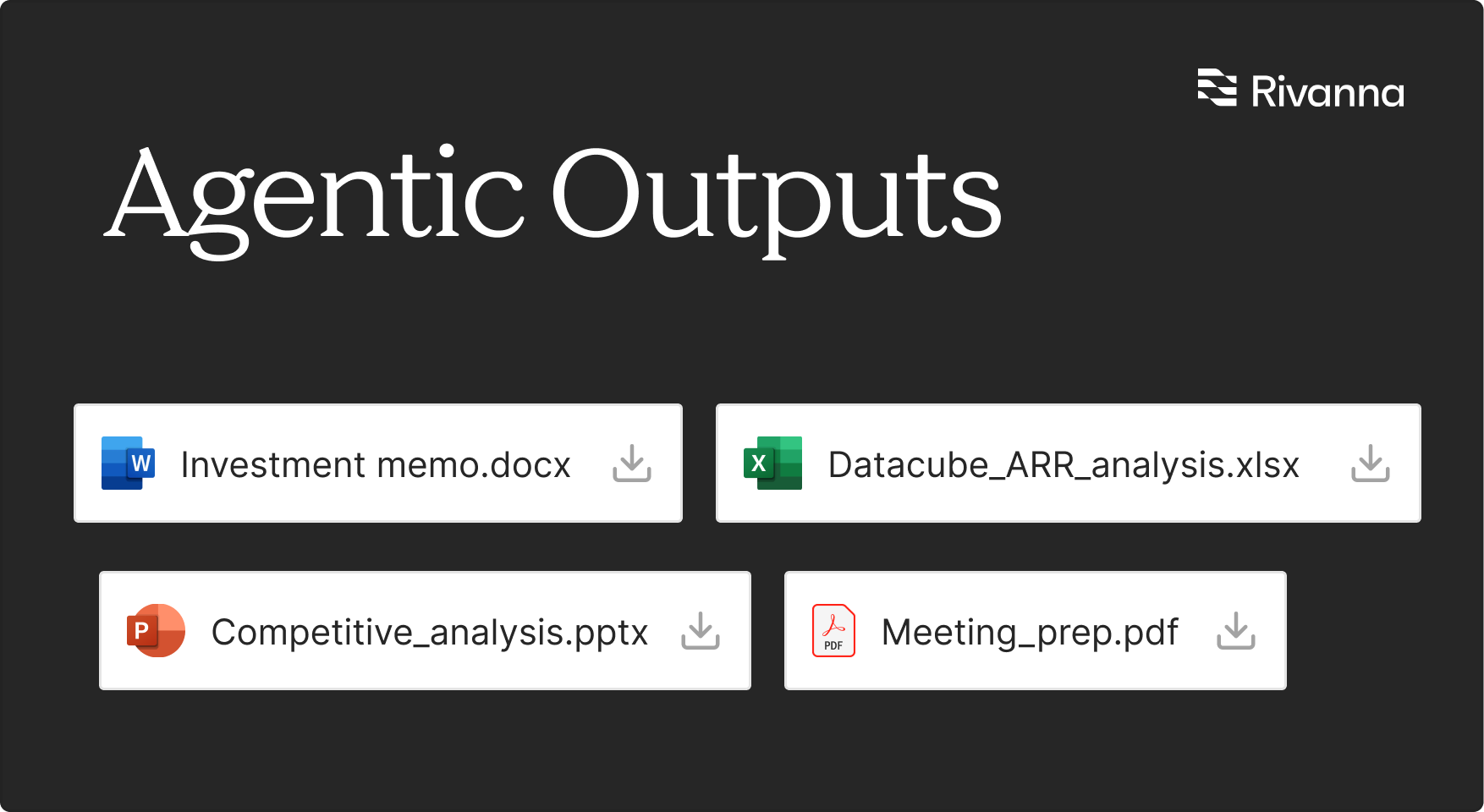
AI can accelerate drafting, allowing deal teams to focus more time on narrative clarity, investment framing, and decision-quality output.
8) Automates and scales expert call workflows
Expert calls remain a critical channel for developing differentiated perspectives. However, the process is often constrained by coordination overhead and calendar bandwidth.
AI is already beginning to automate key components of expert call workflows—scheduling calls, generating interview guides, capturing structured notes, and synthesizing insights—then feeding takeaways back to the investment team for evaluation and decision-making.
9) Leverages institutional knowledge at scale
Today, critical institutional knowledge (past deal materials, IC memos, diligence notes, expert calls, and portco learnings) is fragmented across file systems and teams, making it difficult to search, compare, or systematically reuse.
AI makes this knowledge instantly searchable and analyzable, enabling investors to surface precedents, detect patterns across sectors and themes, and underwrite with the benefit of the firm’s accumulated experience.
10) Enhances quantitative analysis and modeling
As AI capabilities mature, a future state of private markets investing will include AI-driven quantitative analysis at significantly greater speed and scale. This includes structured analysis of large data sets (e.g., operating metrics, cohort data, data cubes) to produce accurate benchmarking and formatted outputs, as well as the construction of financial models where underlying assumptions and logic are transparently grounded in source data.
ROI will be felt in faster, higher-quality decision making
While the return on investment from AI can be measured through reduced time spent on individual tasks, we believe the more important impact is systemic.
Taken together, these capabilities will enable investment firms to operate at a fundamentally higher velocity and analytical depth, which ultimately translates into superior investment outcomes.
Firms that leverage AI well will be able to:
- Accelerate diligence timelines without sacrificing rigor
- Incorporate materially more information into the underwriting process
- Iterate more quickly on hypotheses and investment theses as new data emerges
Over the next five years, we believe operating without AI will increasingly resemble operating without Excel: technically possible, but structurally uncompetitive for firms seeking to perform at the highest level.
The role of the analyst becomes more strategic
AI tooling will restructure the allocation of time and talent across investment teams. Junior professionals, rather than spending the majority of their effort on repetitive process execution and rote analytical work, will need to become adept at higher-order diligence and reasoning tasks, including:
- testing assumptions,
- surfacing second-order risks,
- identifying inconsistencies or missing data,
- pressure-testing the investment thesis,
- and engaging in thoughtful back-and-forth with the AI to challenge conclusions.
In this model, AI is not a replacement for investor judgment; it is a force multiplier that creates more room for judgment to be exercised.
For professionals entering private equity and institutional finance, this shift is a net positive.
Historically, the first several years in finance have been defined by high volume, high repetition, and limited time for deep thinking. AI changes that equation. It creates the potential for junior talent to contribute meaningfully earlier—to engage with the analytical heart of investing rather than primarily executing the mechanics around it.
Why we’re excited at Rivanna
At Rivanna, we believe our work of building AI-native infrastructure for institutional investing is deeply consequential.
Because investment firms collectively steward trillions of dollars of capital, improvements in underwriting rigor and decision velocity compound across the economy. Better capital allocation will enable the collective resources of society to flow more efficiently toward their highest and best use, compounding into higher growth, faster innovation, and a more dynamic economy.
We believe that this will be among the most meaningful real-world impacts of generative AI, and we are excited to partner with forward-looking firms to help bring this future into practice.
Richard Song
CEO & Co-Founder